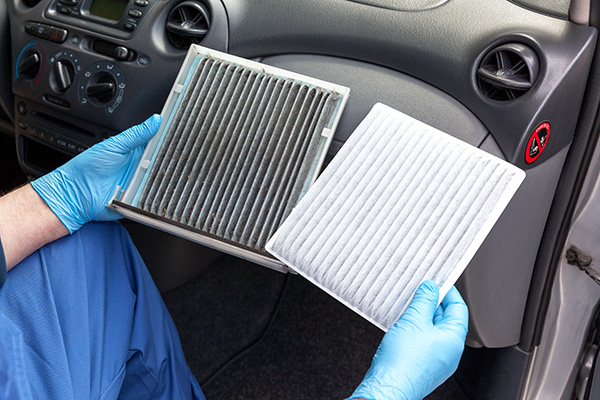
You're stuck in traffic behind a smoky truck, and the air coming through your vents smells like exhaust. Someone suggests a charcoal cabin air filter instead of the standard one. Is it worth paying more? Activated carbon helps absorb certain odors and gases that ordinary particle media doesn't target. But it doesn't turn the car into a sealed clean-air room, and the standard filter still does an important job.
How Standard Cabin Air Filters Clean the Air Entering Your Car
The cabin air filter sits in the heating and air conditioning system, usually near the glove box or windshield intake.
As outside air passes through it, the filter media catches particles such as dust, pollen, road grit, and other airborne debris. A clean filter also helps prevent larger material from collecting deeper in the ventilation system.
A standard filter doesn't have to contain charcoal to work well on particles. The actual filtration performance depends on its media, quality, and fit. When a filter becomes clogged, the vents deliver less air, and windshield clearing takes longer. Replacing a heavily loaded standard filter often improves airflow even when no special odor-control layer is involved.
What Activated Charcoal Adds to Cabin Air Filtration
Activated carbon, often called charcoal in automotive filter descriptions, contains a large internal surface area with sites that adsorb certain gases and odor-causing molecules.
A charcoal cabin filter combines that material with particle-filtering media. The result is a filter that tackles certain smells and gaseous pollutants in addition to dust and pollen.
That benefit is noticeable in stop-and-go traffic, where exhaust odors often enter through the vents.
The carbon layer isn't equally effective against every gas, and it has a limited capacity. Once the available adsorption sites become saturated, its odor-control performance decreases even if the filter still looks relatively clean. The additional layer offers a real benefit, but not unlimited protection.
Does a Charcoal Filter Remove Exhaust Smells Better?
A well-designed activated carbon filter generally reduces certain exhaust-related and outside odors better than a comparable standard particle-only filter. The results vary with the odor, amount of activated carbon, filter condition, and the HVAC system's fresh-air or recirculation setting.
It shouldn't be treated as protection against dangerous carbon monoxide exposure or an exhaust leak entering the cabin. If you smell exhaust inside the vehicle when the windows are closed, especially during idling, have the exhaust and ventilation systems inspected promptly. Headache, dizziness, or nausea while driving are warning signs to pull over and seek help. A cabin filter is not a repair for exhaust gases entering through a leak.
When a Charcoal Cabin Filter Is Worth the Extra Cost
Some drivers spend most of their commute on open roads where odors aren't a major issue. Others sit in dense traffic, drive near industrial areas, or frequently notice fumes from surrounding vehicles. The second group is more likely to appreciate the carbon layer. In Lawndale and the surrounding Los Angeles area, that difference is familiar to anyone who spends time in slow traffic.
Before upgrading, consider these conditions:
- Frequent driving in stop-and-go traffic
- Outside odors entering through the vents
- Allergies aggravated by airborne particles
- An overdue or visibly loaded cabin filter
- Proper filter fit in the original housing
A charcoal filter doesn't automatically capture more pollen than every standard filter. Compare particle ratings and fit, as well as the activated carbon layer.
Why the Cabin Filter Doesn't Fix Every Musty Smell
A musty odor when the A/C starts often has more to do with moisture inside the ventilation system than outside pollution.
The evaporator collects condensation during cooling, and poor drainage or built-up debris can encourage unpleasant smells. A damp cabin filter can also develop odors if water is entering its housing.
Changing to charcoal might mask some smells temporarily, but it doesn't fix the drain, water leak, or dirty evaporator. Persistent odors call for a closer look at the source. If the cabin filter is wet, simply installing another one leaves it exposed to the same moisture. A clean, dry ventilation system and strong airflow matter as much as the filter media.
How Often Should a Charcoal Cabin Filter Be Replaced?
Follow the vehicle's maintenance schedule and inspect the filter sooner when conditions are dusty, or the vents lose airflow. Activated carbon capacity isn't easy to judge by color, so a filter that looks clean might have lost much of its odor-control benefit. Persistent outside smells after long use are one reason to check the replacement interval.
Avoid washing or spraying an ordinary disposable charcoal filter unless the manufacturer specifically approves that procedure.
Water or cleaning chemicals may affect the media and carbon layer. A replacement should match the correct dimensions and airflow direction. Poor fit allows air to bypass the filter and defeats both particle and odor control, regardless of how much charcoal the filter contains.
Choosing the Right Cabin Air Filter for Your Vehicle
We look at the original filter design, the owner's driving conditions, and the available compatible replacement options. A quality standard cabin filter handles dust and pollen well for many drivers. A properly fitted activated carbon filter adds value when reducing certain outside odors is a priority. There's no reason to buy an expensive filter solely because the box uses technical language.
If the problem is weak airflow, we inspect the filter and blower operation. For an unpleasant smell, the inspection separates outside odors from moisture and buildup inside the ventilation system.
Fixing the cause of the odor or airflow problem is more effective than buying a filter with a long list of claims.
Get Cabin Air Filter Replacement in Lawndale, CA, With Rick's Automotive Service
Rick's Automotive Service in Lawndale, CA, inspects cabin filters and HVAC airflow, then helps you choose between standard and activated carbon options that fit the vehicle correctly.
If traffic odors bother you, ask about a charcoal filter at your next service visit, but don't use one to cover up a possible exhaust leak.